Street Fighter (2026)
Ready. Set. Fight.
Few video game franchises are as instantly recognizable as Street Fighter. First unleashed upon arcades by Capcom in 1987, the brainchild of Japanese game designers Takashi Nishiyama and Hiroshi Matsumoto, the series became a worldwide phenomenon with the arrival of Street Fighter II in 1991, introducing generations of players to a colorful collection of martial artists, spectacular special moves and the occasional shattered controller. Hollywood, however, has had considerably less success translating those thrills to the big screen. The gloriously ridiculous 1994 adaptation starring Jean-Claude Van Damme and Raúl Juliá was hardly a critical triumph, while 2009’s Street Fighter: The Legend of Chun-Li proved even more disastrous. Now, more than three decades after that first cinematic outing, the franchise returns for another round, promising to deliver the ultimate live-action experience. Unfortunately, despite some promising ingredients, this latest attempt is a chaotic, irritating and frequently incomprehensible mess that struggles to land even its simplest punches.
The story opens in 1987, with an anime-style flashback exploring the relationship between childhood friends and martial arts students Ryu (Andrew Koji) and Ken Masters (Noah Centineo). Training under their wise master Gouken (voiced by Don Lee), the pair develop a brotherly bond that is eventually shattered by tragedy. Playing a significant role in their separation is Akuma (Joe “Roman Reigns” Anoa’i), Gouken’s younger brother and a ruthless martial artist consumed by dark power. Beautifully animated, these sequences recall the visual style of 1994’s Street Fighter II: The Animated Movie, providing an affectionate nod to the franchise’s Japanese roots while establishing an emotional foundation for the story. It’s an encouraging start, suggesting that perhaps this time the filmmakers understand what makes these characters so enduring.
That early promise quickly evaporates once the animation gives way to live action.
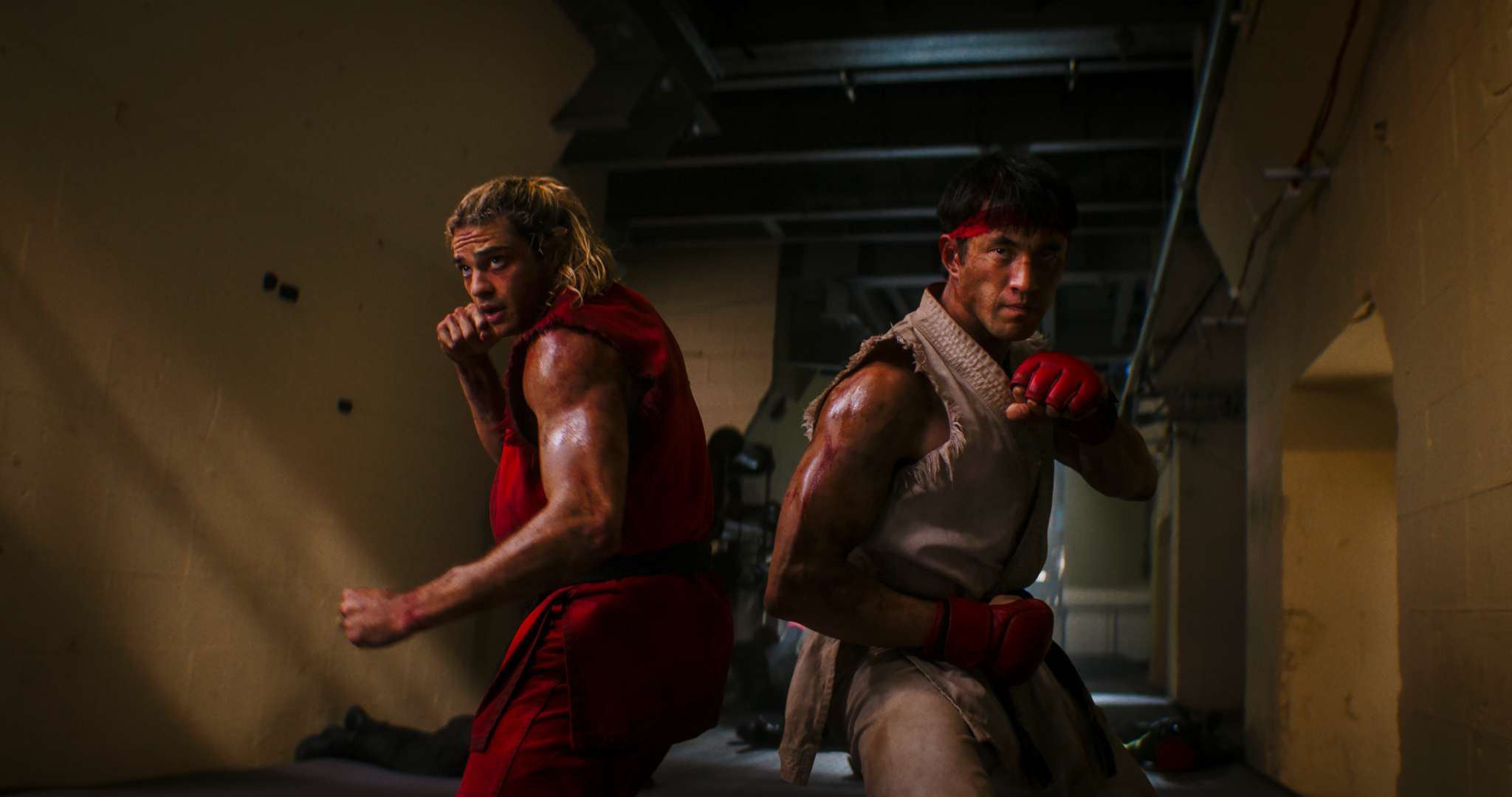
The year is 1993, and the once-inseparable fighters have taken very different paths. Ken has become a self-absorbed celebrity, more interested in fame, partying and his own inflated ego than the discipline that made him a champion. Ryu, meanwhile, has withdrawn from the spotlight, struggling with the darkness within himself and the consequences of his past. Their paths unexpectedly cross when Chun-Li (Callina Liang), a determined Interpol agent investigating the activities of the sinister M. Bison (David Dastmalchian), recruits them for the World Warrior Tournament, a competition bringing together the world’s greatest fighters. However, behind the spectacle lies a dangerous conspiracy involving Bison’s power-hungry ambitions and Ryu’s mysterious abilities.
On paper, there is enough material here for an exciting martial arts adventure. Instead, director and co-writer Kitao Sakurai, whose previous credits include Bad Trip (2021) and The Eric André Show (2012-23), seems far more interested in creating an obnoxiously loud comedy than telling a coherent story. His background in nutty humor is evident, but that sensibility proves an exceptionally poor fit for a production requiring carefully developed characters, genuine dramatic tension and a reasonably clear narrative. The result is an exhausting combination of crude jokes, frantic editing, excessive shouting and increasingly offbeat sequences that rarely come together.
The screenplay by Sakurai and T.J. Fixman is all over the place. Characters make decisions that seem dictated more by the demands of the next sequence than anything resembling believable motivation. Ryu initially refuses to participate in the tournament, only to arrive later, defeat E. Honda (Hirooki Goto) and take his place, while Ken’s motivations fluctuate between maintaining his celebrity status, settling old grievances and ‘saving’ his former friend. Chun-Li’s investigation becomes increasingly consumed by her personal vendetta against Bison, whose elaborate scheme to harness Ryu’s mysterious powers involves staging an international fighting competition, kidnapping his intended target and subjecting him to bizarre experiments. Meanwhile, the supernatural connection between Ryu and Akuma is explained through scattered flashbacks and hurried revelations that raise almost as many questions as they answer. Rather than allowing these various storylines to develop naturally, the screenplay throws everything together with little consideration for narrative coherence, leaving the tournament itself feeling strangely insignificant. There’s a difference between deliberately embracing the absurdity of the source material and simply failing to make sense of it. Street Fighter frequently mistakes one for the other.
Compounding these problems is the remarkable achievement of making its three principal characters so thoroughly unlikeable. Ken is an arrogant, insufferable egotist, Ryu is a humorless drag, and Chun-Li is unnecessarily aggressive and unpleasant, even attacking her Interpol superiors when they attempt to remove her from the investigation. There’s nothing wrong with portraying flawed protagonists, but there needs to be something beneath those flaws worth caring about.
The underlying themes of brotherhood, rivalry, redemption and the corrupting influence of power are similarly mishandled. Ryu and Ken’s fractured friendship should provide the emotional heartbeat, while Akuma’s embrace of destructive power offers an obvious contrast to Ryu’s struggle for self-control. Instead, these potentially interesting ideas are explored with little conviction, repeatedly undermined by awkward comedy and an almost pathological refusal to allow a dramatic moment to breathe. Even Chun-Li’s pursuit of justice is given insufficient depth. There are worthwhile themes buried beneath the confusion, but the screenplay never gives them the attention they deserve.
At least the character designs demonstrate a genuine appreciation for the games. Indian action star Vidyut Jammwal makes an impressive visual match for Dhalsim, the spiritual yoga master renowned for his extraordinary flexibility, while the towering Olivier Richters looks suitably intimidating as Zangief, the muscle-bound Russian professional wrestler. The fight sequences are another highlight, boasting energetic choreography and plenty of familiar special moves, from E. Honda’s rapid-fire slaps to Chun-Li’s acrobatic kicks and Dhalsim’s extraordinary stretching abilities. Even an early confrontation between Ken and Ryu is handled with a playful inventiveness that captures the spirit of the games. For all its shortcomings, Street Fighter delivers plenty of excitement when the fists start flying.
The characters may look the part, but the world around them is considerably less convincing. Sakurai’s interpretation of the early 1990s is certainly colorful, with its outrageous fashions and elaborate hairstyles, but the execution is disappointingly artificial. Much of the action unfolds against an endless assortment of garish, neon-drenched environments that resemble cheaply constructed nightclub sets rather than believable locations. The aesthetic is frequently tacky, with overbearing lighting and shoddy visual effects creating an oddly hollow appearance. Sure, it’s cool to embrace the heightened reality of a video game, but the best adaptations still manage to create a convincing world. Here, the whole thing looks as though it was assembled from whatever fluorescent decorations the production department could find.
The soundtrack is another bewildering affair. One of the more prominent musical selections is 4 Non Blondes’ 1993 hit “What’s Up?”, whose repeated question, “What’s going on?”, rather appropriately sums up the entire experience. Indeed, that very question kept running through my mind for almost the entire screening. Elsewhere, the music selection takes a rather carefree approach to chronology. Despite the story being set in 1993, the soundtrack features Soundgarden’s “Black Hole Sun,” released in 1994, and the Baha Men’s “Who Let the Dogs Out?”, which didn’t arrive until 2000. More glaringly, characters are actually seen listening to Meredith Brooks’ “Bitch,” a song released in 1997. While using later recordings as non-diegetic music can be excused as artistic license, having characters listen to songs that won’t exist for years is considerably harder to justify. Apparently, the World Warrior Tournament also involves time travel.
As for the performances, the central trio are perfectly serviceable, although all three are severely disadvantaged by the material. Centineo brings some energy to the cocky Ken, Koji handles the physical demands of Ryu reasonably well, and Liang demonstrates considerable athletic ability as Chun-Li. However, none is afforded the character development necessary to make their respective journeys particularly compelling. The supporting cast, surprisingly, provides most of the entertainment.
David Dastmalchian is an enjoyable presence as M. Bison, the megalomaniacal dictator and leader of the criminal organization Shadaloo, bringing a theatrical quality to the villain despite having comparatively little of substance to do. Professional wrestler Cody Rhodes is reasonably amusing as Guile, the patriotic American military officer sporting his trademark gravity-defying blond haircut, although his attempts at comedy often feel too random and forced. Andrew Schulz fares best as Dan Hibiki, the franchise’s notoriously overconfident and comically inept martial artist, reimagined here as Ken’s opportunistic manager. His performance is one of the few that successfully embraces the inherent silliness while giving the character a surprising amount of depth.
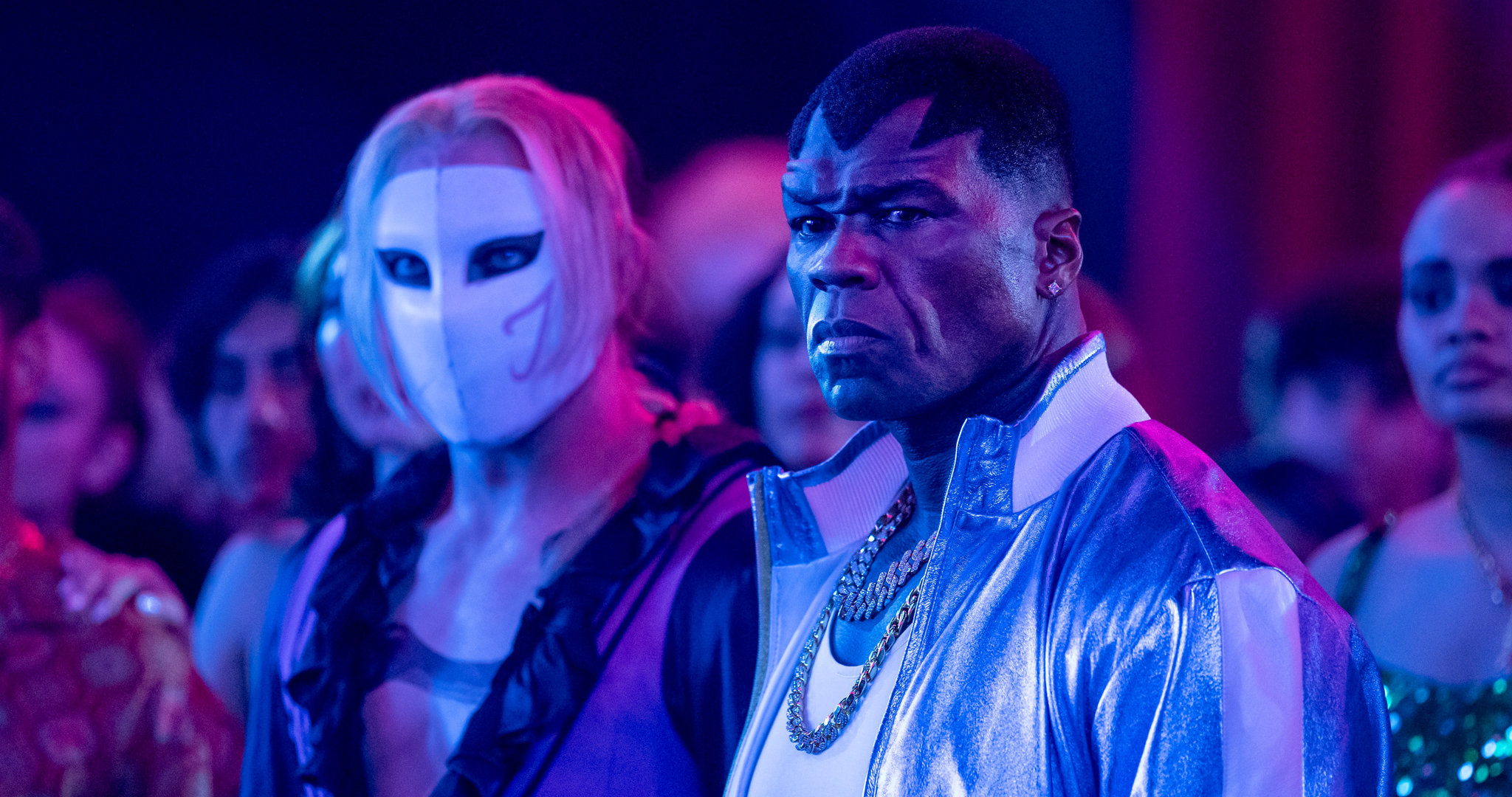
Elsewhere, Curtis “50 Cent” Jackson’s portrayal of boxer Balrog resembles an overextended Saturday Night Live sketch, while Eric André is painfully unfunny as Don Sauvage, the flamboyant tournament announcer whose incessant antics contribute little beyond additional noise. Jason Momoa is virtually unrecognizable as Blanka, the green-skinned, electrically charged Brazilian fighter, although the character’s thoroughly unconvincing computer-generated appearance represents the very definition of CGI slop.
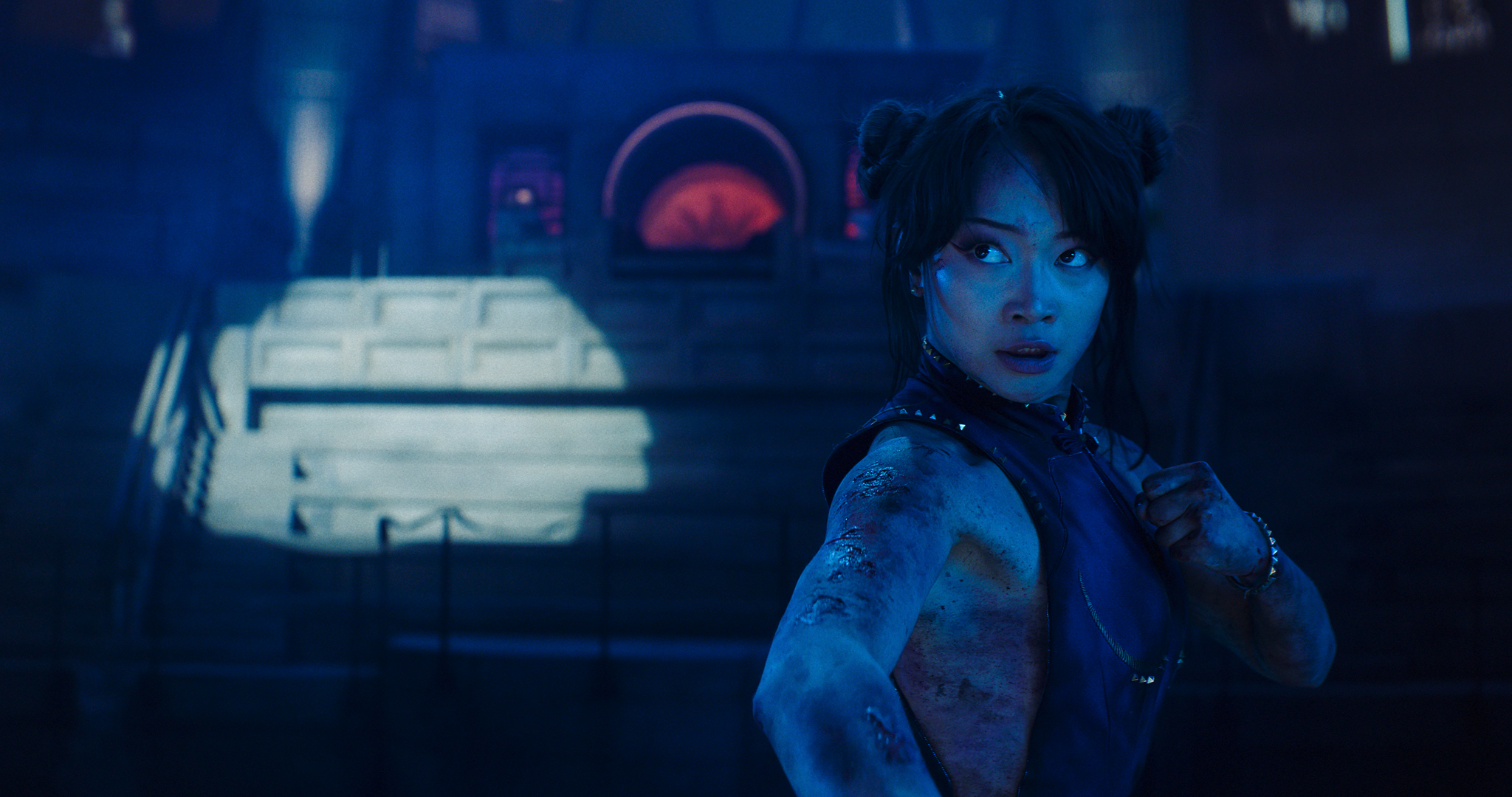
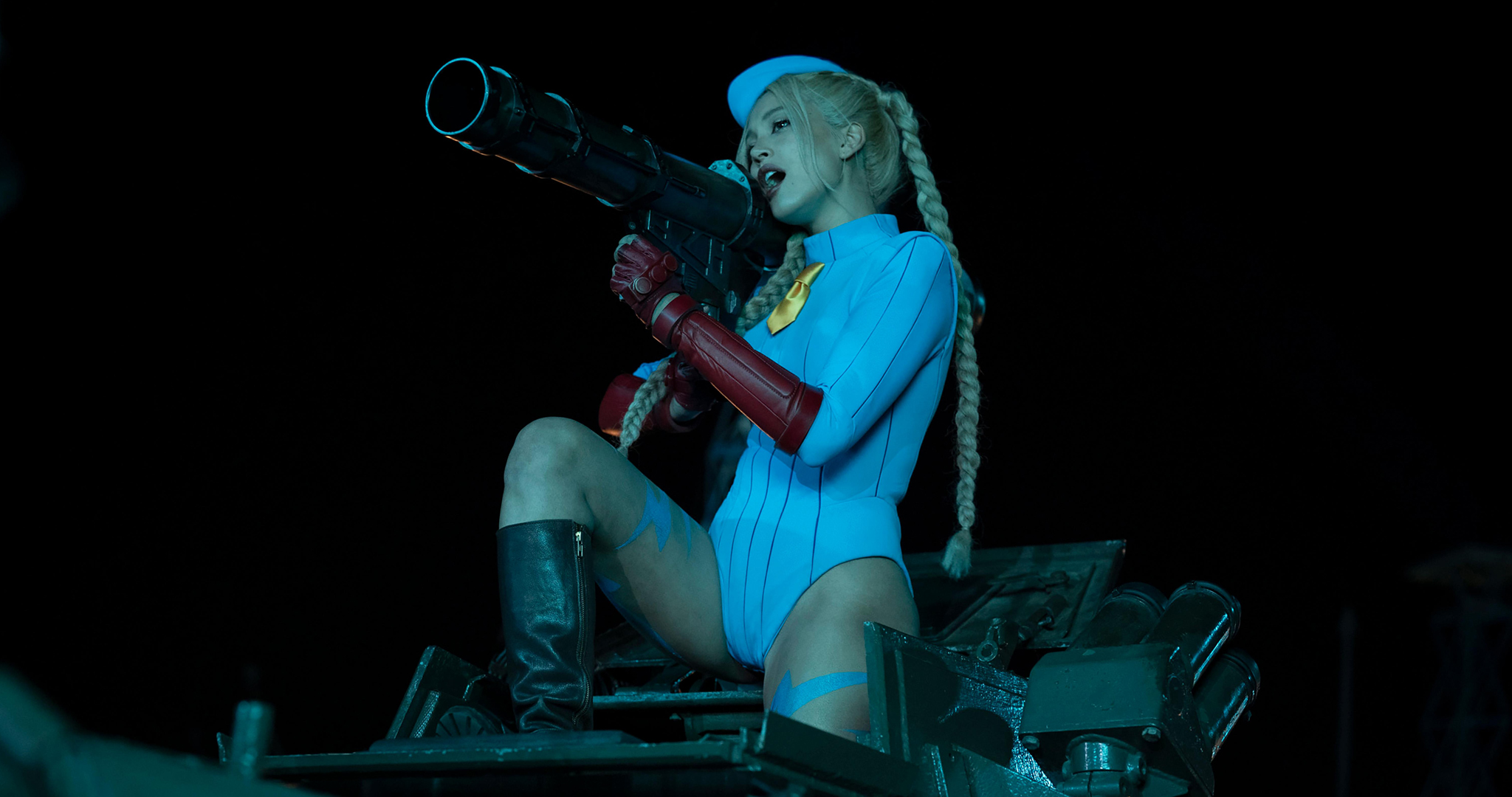
Rayna Vallandingham is decent in her limited appearances as Juli, one of Bison’s loyal assassins, while Mel Jarnson does what she can with Cammy, the formidable British fighter whose complicated history with Shadaloo is an important element of the games. Here, Cammy is portrayed in her earlier ‘Killer Bee’ incarnation, serving Bison as one of his brainwashed Dolls. That’s perfectly fine, but rather than the cold, disciplined assassin fans know, she’s been reinvented as a bizarre, Harley Quinn-style character, complete with manic outbursts, exaggerated mannerisms and peculiar flirtatious behavior. Considering Cammy has always been my favorite character in the entire Street Fighter series, this interpretation is especially disappointing. Jarnson certainly has the iconic outfit, but this barely resembles the Cammy I fell in love with in the games.
Perhaps the film’s most glaring failure, however, is its dreadful climax. After spending so much time juggling conflicting motivations, supernatural revelations and seemingly endless confrontations, Street Fighter approaches its conclusion with an astonishing lack of dramatic discipline. For a franchise of this stature, the final developments feel remarkably sloppy, offering little of the narrative satisfaction such an elaborate setup demands. Rather than building towards a genuine resolution, the story simply stops, resembling an episode of a television series that expects viewers to tune in the following week to discover what happens next. It’s an embarrassingly amateurish way to conclude a major theatrical release.
In the end, Street Fighter is a hugely disappointing adaptation that mistakes visual accuracy, obnoxious humor and relentless noise for genuine entertainment. There are fleeting moments of promise here and there, and the obvious affection for Capcom’s characters is appreciated. Yet those positives are overwhelmed by an incoherent screenplay, unlikeable protagonists, questionable creative decisions and direction that never manages to bring its competing ideas together. After three attempts at live-action glory, Hollywood still hasn’t figured out how to deliver a truly satisfying Street Fighter experience. This latest contender enters the arena looking ready for a championship victory, only to trip over its own feet, punch itself in the face and collapse before the final bell. Hadouken? More like Hadou-can’t.
2.5 / 5 – Alright
Reviewed by Dan Cachia (Mr. Movie)
Street Fighter is distributed by Paramount Pictures Australia

