Ebenezer (2026)
Before he was Scrooge, he was…
For a man who absolutely despises Christmas, Ebenezer Scrooge has certainly been forced to celebrate it an extraordinary number of times. Ever since Charles Dickens published his beloved novella A Christmas Carol in 1843, the miserable old miser has been visited by more ghosts, endured more festive revelations and discovered the true meaning of Christmas more times than anyone could possibly count. Over the decades, we’ve had Alastair Sim in the 1951 classic Scrooge, Albert Finney in the 1970 musical adaptation, Bill Murray putting a contemporary spin on proceedings in 1988’s Scrooged, and Jim Carrey getting the motion-capture treatment in Robert Zemeckis’ visually extravagant 2009 animated version. However, for my money, nothing has ever come close to Brian Henson’s The Muppet Christmas Carol (1992), featuring Michael Caine as the definitive Ebenezer Scrooge, Kermit the Frog as Bob Cratchit, and the wonderfully charming pairing of Gonzo and Rizzo the Rat narrating the whole affair. It’s funny, heartfelt, beautifully musical and, dare I say, probably the greatest Christmas film ever made. Sorry, Dickens. That’s a tough act to follow.
Nevertheless, Hollywood clearly believes there’s still a little Christmas spirit left to squeeze out of the old humbug, with Ebenezer marking the latest cinematic resurrection of the timeless tale. Directed by horror filmmaker Ti West, best known for his X trilogy, and written by Nathaniel Halpern, the film stars Johnny Depp in the titular role and takes a decidedly darker approach to Dickens’ material, replacing much of the familiar festive warmth with a gloomy, gothic atmosphere straight out of a Victorian nightmare. Evidently, West decided that what A Christmas Carol really needed was fewer jolly Christmas celebrations and a few more things crawling out of the grave. Bah, humbug indeed!
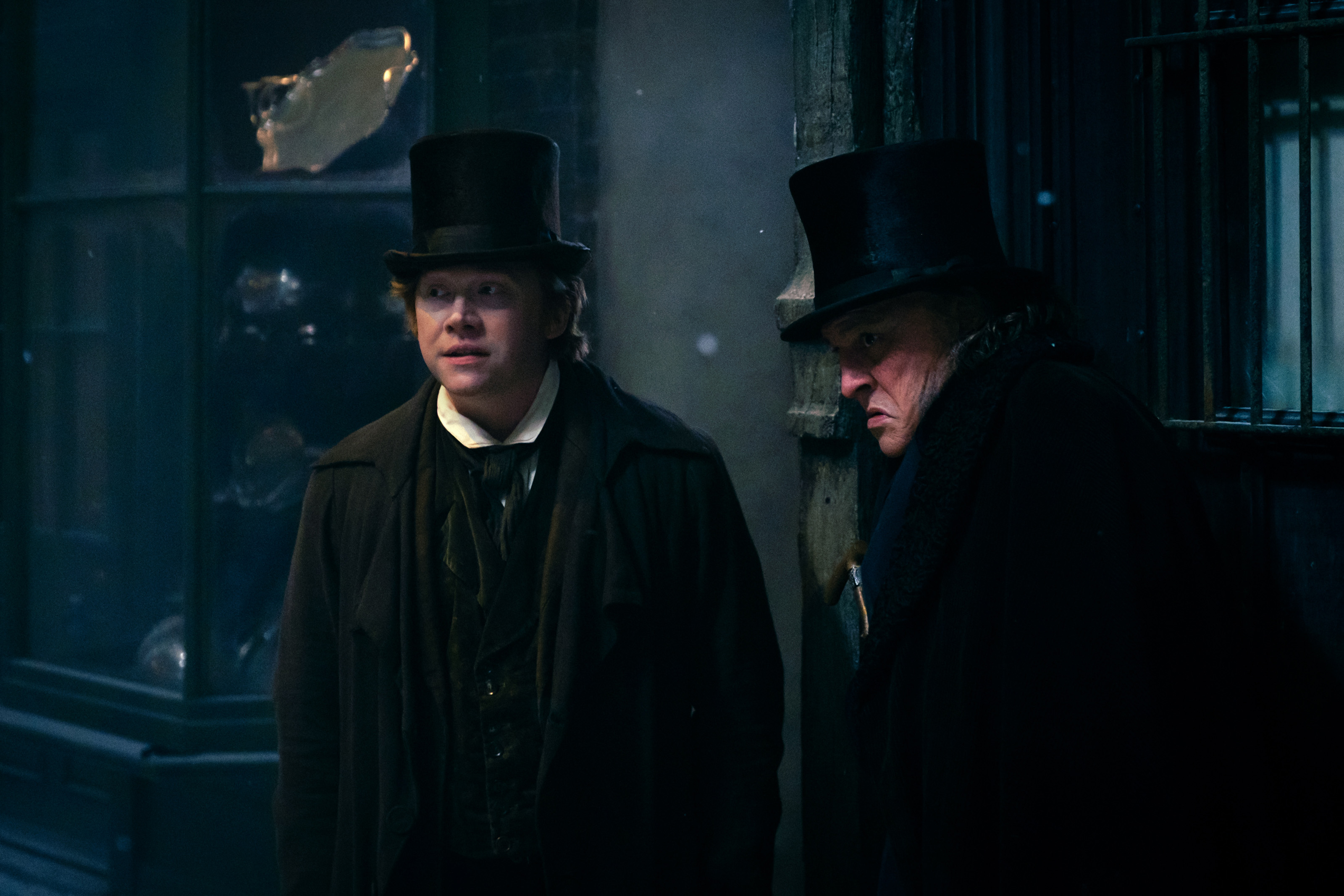
Set against the cold, unforgiving backdrop of Victorian London, the film follows Ebenezer Scrooge (Johnny Depp), a wealthy, bitter and thoroughly unpleasant businessman whose obsession with money has left him almost entirely devoid of compassion. Having spent years accumulating wealth alongside his equally miserable business partner Jacob Marley (Ian McKellen), Scrooge now occupies a lonely existence in which generosity is considered a weakness, happiness an inconvenience and Christmas little more than an irritating interruption to his financial affairs. His long-suffering employee Bob Cratchit (Rupert Grint) is barely afforded the dignity of a warm workplace, while his cheerful nephew Fred (Sam Claflin) and Fred’s wife Clara (Daisy Ridley) represent a kind of familial affection that Scrooge has long since rejected.
However, on one particularly unsuspecting Christmas Eve, Scrooge’s carefully maintained isolation is upended by the supernatural arrival of his deceased business partner, Marley, who appears burdened by the chains of his own earthly greed. Warning Scrooge that he faces an equally miserable fate unless he changes his ways, Marley announces the impending arrival of three mysterious spirits. What follows is a nightmarish journey through Christmases past, present and yet to come, as Scrooge is forced to confront the painful memories that shaped him, the suffering his selfishness continues to inflict upon others, and the terrifying possibility of a future in which his enormous fortune ultimately amounts to absolutely nothing. Whether this miserable old geezer can rediscover his humanity before it’s too late is, of course, the million-pound question. Although, knowing Scrooge, he’d probably charge interest on the answer.
Director Ti West certainly deserves credit for recognizing the inherent horror lurking beneath Dickens’ familiar Christmas fable. After all, strip away the festive decorations, cheerful carols and general sentimentality, and A Christmas Carol is essentially a supernatural morality tale about a deeply troubled man being psychologically tormented by ghosts until he agrees to become a better person. West embraces this darker foundation with considerable enthusiasm, transforming Victorian London into an oppressive landscape of ominous crows, shadowy alleyways, decaying buildings and dilapidated graveyards, where the relentless fog and darkness create a lingering sense of unease. This is a far grimmer interpretation of Dickens’ world, where Christmas cheer feels almost as scarce as Scrooge’s willingness to open his wallet.
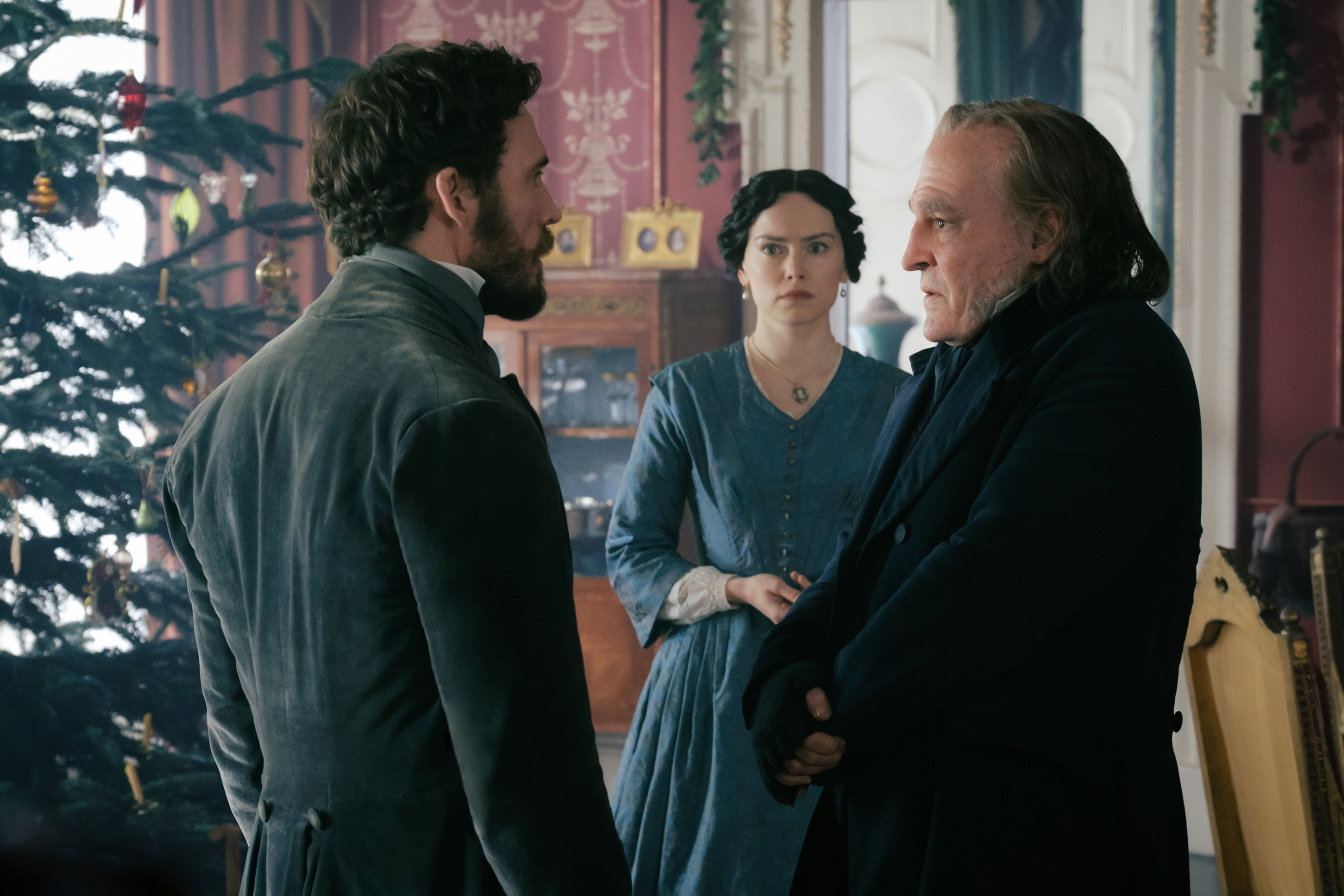
On a visual level, Ebenezer is frequently impressive. Cinematographer Checco Varese makes excellent use of the period setting, bathing the environments in murky shadows, flickering candlelight and desaturated colors that reinforce the increasingly macabre atmosphere. Meanwhile, production designer Eve Stewart deserves considerable praise for recreating a wonderfully detailed Victorian London, complete with cobblestone streets, imposing architecture and filthy urban surroundings. There’s a convincing sense of physicality to the production, with its elaborate sets and atmospheric environments lending the piece a distinctly old-fashioned cinematic quality. West further embraces this aesthetic through his use of 35mm film, retro-inspired opening credits and decorative title cards separating the narrative into its five respective ‘staves,’ mirroring the musical chapter divisions of Dickens’ original novella. These charming stylistic touches make Ebenezer resemble a forgotten gothic production from a bygone era, rather than another overly polished contemporary blockbuster. Old-school filmmaking with a distinctly morbid Christmas makeover.
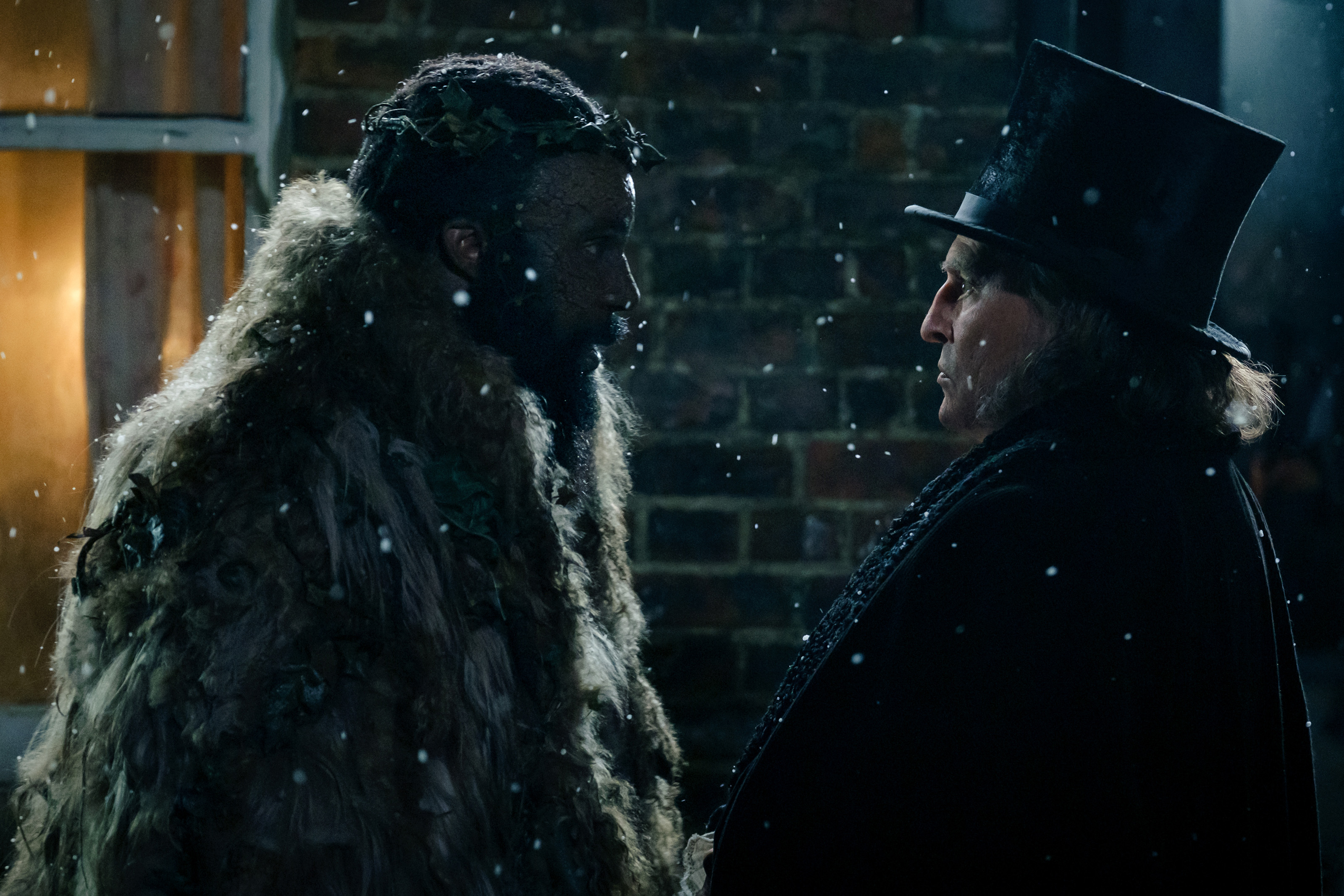
It’s during the supernatural encounters, however, that West’s horror sensibilities become most apparent. The Ghost of Christmas Past (Andrea Riseborough) is particularly eerie, resembling a zombie-like apparition whose pale complexion, lifeless eyes and unnatural movements make her feel as though she’s wandered directly out of a Victorian crypt. Riseborough gives the character an appropriately otherworldly presence, creating an unnerving contrast to the more delicate and ethereal interpretations audiences may remember. Meanwhile, Tramell Tillman brings an imposing physicality to the Ghost of Christmas Present, whose initially commanding appearance gradually gives way to something far more disturbing. One particularly surprising body-horror sequence involving the spirit’s deteriorating form is easily among the film’s most memorable moments, offering a ghoulish little reminder of West’s background in horror. Even the familiar Ghost of Christmas Yet to Come feels particularly foreboding amid the movie’s increasingly oppressive imagery.
These creative departures certainly make the familiar material somewhat more interesting, particularly for those of us who practically know the story off by heart. There’s genuine entertainment to be found in seeing how West reinterprets the various supernatural encounters, and the occasional grotesque surprise helps distinguish this version from its numerous predecessors. Unfortunately, while the increased dread and gothic presentation give Ebenezer a distinctive visual identity, the film occasionally becomes so preoccupied with its own grimness that the actual Christmas spirit begins to disappear beneath the shadows. And therein lies its biggest problem.
For all the haunting imagery and impressive production values, I couldn’t help missing the warmth, humor and infectious festive energy that make the better adaptations so endlessly rewatchable. There’s something wonderfully comforting about watching Gonzo and Rizzo guide us through Dickens’ tale, accompanied by the delightful Christmas songs of The Muppet Christmas Carol. Those musical interludes, colorful characters and moments of genuine tenderness provide an emotional balance that West’s interpretation struggles to replicate. While Ebenezer is undoubtedly more frightening, its determination to remain spooky and foreboding sometimes diminishes the joy that should accompany Scrooge’s eventual transformation. The ghosts may be scarier, but the Christmas magic isn’t nearly as enchanting. Frankly, I would have welcomed a few singing penguins to lighten the mood.
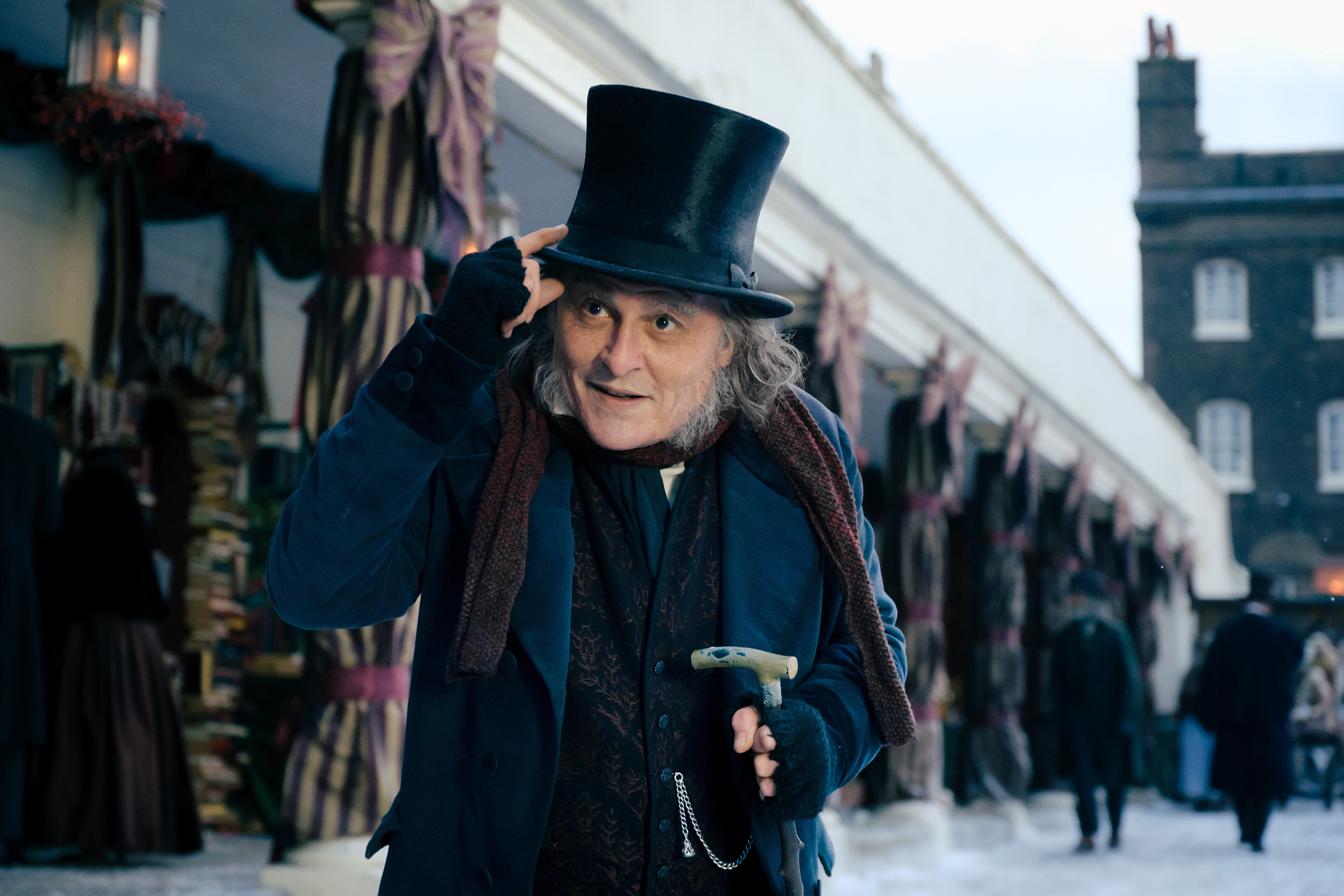
As for Johnny Depp, the actor delivers a perfectly decent performance as the legendary miser, adopting the character’s familiar scowl, hunched posture and general contempt for humanity with reasonable conviction. However, despite his considerable screen presence, there’s something strangely underwhelming about his interpretation. Depp is certainly capable of portraying eccentric, larger-than-life characters, but his Scrooge rarely feels particularly distinctive beyond the elaborate makeup and customary grumpiness. Much of his performance follows the familiar emotional trajectory we’ve witnessed countless times before, without introducing enough interesting nuances to make this particular incarnation especially memorable. It’s not necessarily a bad performance, merely one that feels rather generic, blending into the many interpretations that have preceded it. There is, however, an amusing nod to Depp’s cinematic debut in Wes Craven’s A Nightmare on Elm Street (1984), with Scrooge being sucked into his bed, much like Depp’s unfortunate character in the horror classic. Talk about a nightmare before Christmas!
The supporting ensemble is consistently good. Rupert Grint brings an appealing sincerity to Bob Cratchit, portraying the overworked employee and devoted father to the ailing Tiny Tim (Freddie Lee-Grey) with warmth and quiet resilience, while Sam Claflin makes for an appropriately optimistic Fred, whose unwavering attempts to reconnect with his uncle provide some much-needed humanity. Daisy Ridley is equally effective as Fred’s wife Clara, although her relatively limited screen time leaves little opportunity to make a substantial impression. Meanwhile, the ever-reliable Ian McKellen brings considerable theatrical gravitas to Jacob Marley, making him an appropriately imposing presence both in the film’s opening and during his later supernatural warning.
Naturally, the underlying themes of Dickens’ story remain largely unchanged. We’ve heard this Christmas sermon countless times before, and dressing it in black doesn’t necessarily make the message any more profound. Greed, poverty, compassion, regret and the possibility of personal redemption continue to form the moral foundation of the narrative, reminding audiences that material wealth means very little when accompanied by emotional isolation and indifference towards others. These are timeless ideas that remain just as relevant today as they were in Victorian England, particularly when examining the divide between the wealthy and the less fortunate. West and screenwriter Halpern also introduce new incidents involving beggars and charity collectors, seemingly intended to provide some justification for Scrooge’s hostility towards those seeking assistance. Alas, these alterations feel so brief and heavy-handed that they do little to deepen his character, ultimately cheapening the emotional impact of his eventual redemption.
In the end, Ebenezer remains a solid reinterpretation of a much-loved literary classic, offering audiences a darker alternative to the usual festive entertainment. Ti West’s gothic sensibilities and impressive production design provide enough visual intrigue to justify another trip through Scrooge’s haunted past, even if the familiar narrative and serviceable central performance prevent it from becoming something truly special. West has certainly put the haunt back into the holiday season, delivering a Christmas Carol that’s less about decking the halls and more about digging the graves. However, no matter how many times Hollywood resurrects Dickens’ beloved creation, I suspect I’ll always return to Michael Caine, Kermit, Miss Piggy, Gonzo, Rizzo and those wonderful Christmas songs. The Muppet Christmas Carol will forever remain the definitive interpretation in my eyes. Dare I say, it’s even better than Dickens’ original. Sorry, Charles. For a story called A Christmas Carol, you really should have included a few actual musical numbers.
3 / 5 – Good
Reviewed by Dan Cachia (Mr. Movie)
Ebenezer is distributed by Paramount Pictures Australia

