Christy (2025)
What does it take to become a legend?
Christy Martin’s story already plays like a movie that feels ripped from late-night cable in the 1990s — equal parts American dream, tabloid nightmare, and sheer stubborn resilience. Born and raised in small-town West Virginia, Martin (born Christy Salters) became one of the first genuinely mainstream stars of women’s boxing, breaking through at a time when the sport barely had the infrastructure — or respect — to support her. She fought on big cards, became a recognizable face in a very male arena, and built a public persona that was all grit, swagger, and bloody-knuckled determination. And then, in 2010, her private life became the kind of headline that swallows everything: her husband and manager, James V. Martin — commonly known as Jim — attempted to murder her.
That’s the real-world shadow hanging over David Michôd’s biographical drama Christy — a film that tries to honor the “trailblazer” narrative while staring unflinchingly at the darker truth underneath the gloves. The result is often gripping, sometimes beautiful, occasionally frustrating, and ultimately hard to shake.

Our story starts in West Virginia, where Christy Martin (Sydney Sweeney) is a college athlete who stumbles into a local women’s boxing competition and discovers she has a rare gift — she can hit, she can take a hit, and she can keep coming. Enter Jim Martin (Ben Foster), a local coach who immediately recognizes Christy’s potential and offers to train her — and, before long, to shape her entire life. With James guiding her rise, Christy begins climbing through the ranks, stepping into the ring in her now-iconic pink trunks — a visual trademark that makes her impossible to miss and even harder to dismiss. As her profile grows, the film tracks the collision between her public persona and her private reality, including the fact that she is a closeted gay woman in an environment that is anything but safe or honest. The higher she climbs in the boxing world, the more pressure there is to perform strength, toughness, and normalcy, even as the cost of that performance begins to mount. At home, Christy’s family life is textured and complicated. Her mother Joyce Salters (Merritt Wever) loves her deeply but struggles with judgment, denial, and the limits of what she’s willing to see. Her father John Salters (Ethan Embry) is steadier and more quietly supportive, offering a grounding presence even when he doesn’t fully understand the world his daughter is entering.
Plot-wise, the film moves from Christy’s early discovery of her boxing talent, through her relocation and rapid career acceleration, and into the tightening grip of Jim’s control — a relationship that gradually shifts from a seemingly supportive partnership into something far uglier and far more dangerous. It follows the familiar arc of a sports biopic … until it doesn’t. While the ring remains important, the film makes it clear that the real fight is no longer happening under bright lights and roaring crowds, but at home, behind closed doors, where applause can’t reach and trophies offer no protection.
Whatever you think of the screenplay’s priorities (we’ll get there), filmmaker David Michôd directs the hell out of this thing. There’s a steadiness to the filmmaking — a confidence that doesn’t need to shout. It’s not flashy for the sake of it, but it’s never flat, either. Visually, the film often looks like a proper period piece. Not in the “hey look, we found a vintage Pepsi sign” way, but in the textures: gyms that feel lived in, motel rooms that feel too familiar, small-town interiors that carry a kind of soft claustrophobia. Germain McMicking’s cinematography gives the movie a grounded, observational quality — the sense that we’re watching a life unfold rather than being marched through a checklist of iconic moments. The retro soundtrack — featuring tracks like “Bust a Move” by Young MC and “Head Over Heels” by Tears for Fears — quietly reinforces that approach, supporting the emotional undercurrent without ever overpowering it. Rather than feeling like attention-grabbing nostalgia drops, the music works in tandem with the visuals, underscoring tension, momentum, and isolation in a way that feels purposeful and restrained.
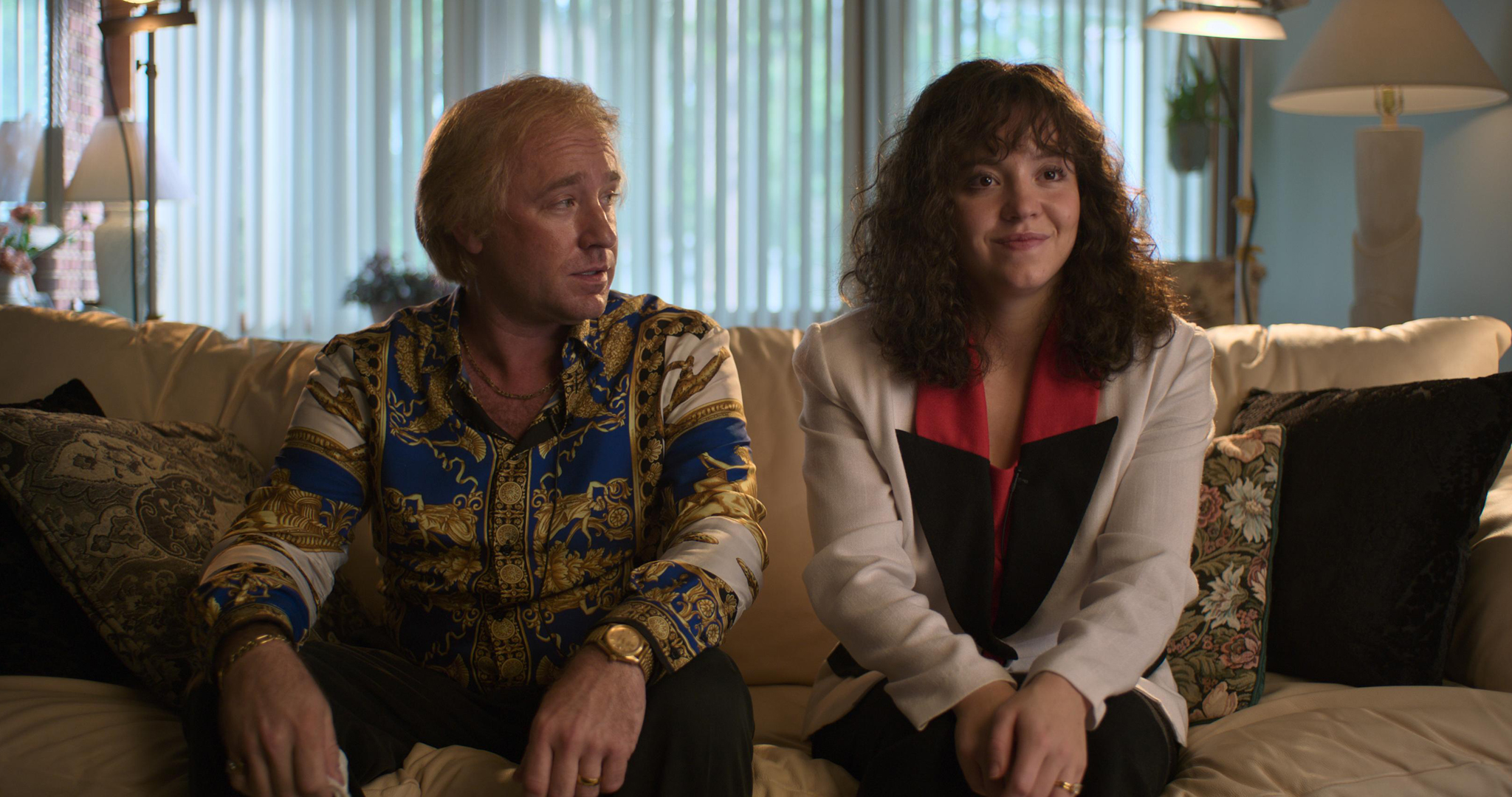
Alas, here’s where Christy starts to wobble. On paper, it wants to be two things at once: a sports rise story about a woman battering her way into the mainstream, and a dark relationship drama about coercive control, addiction, and violence. Both are real. Both matter. But the screenplay — credited to Mirrah Foulkes and David Michôd, from a story by Katherine Fugate — isn’t always sure which movie it wants to be at any given moment. When the film pivots sharply into the domestic space, the boxing narrative begins to feel like background noise, as though the sport itself is less the subject and more the stage on which the real drama unfolds. That’s not an illegitimate approach; in fact, there’s a strong argument that it’s the more important story to tell. The issue is balance. The transitions between these two modes can feel abrupt, and the momentum occasionally falters, giving the impression that the film is toggling between genres rather than weaving them together. The result is a film that’s powerful in sections, but occasionally blunted by indecision. You can almost feel two great films inside it — one about a trailblazing athlete, the other about the anatomy of abuse — competing for oxygen.
Even when the focus slips, the themes come through loud and clear. Identity is a big one: Christy performing toughness for the world while trying to make sense of herself privately — her sexuality, her needs, what she’s allowed to want, and what she’s been trained to hide. Then there’s power — not just in the ring, but in relationships, money, image, and public narrative. It understands how fame can trap you: once you’re “the tough one,” you’re expected to stay tough, even when the danger isn’t coming from an opponent across the canvas. And of course, there’s violence itself — the uncomfortable idea that a person can normalize brutality as “part of the job,” and how that normalization can make other forms of harm harder to name, harder to escape. A film like this almost dares you to ask: If you can survive a beating in front of cameras, why can’t you survive the one no one sees? That’s a cruel question society asks victims all the time — and Christy makes you sit with it.
Despite any reservations about the script’s juggling act, the cast is relentlessly strong. Sydney Sweeney is the engine. This is a legitimately transformative performance as Christy Martin — not just physically, but in the details: posture, voice, the way she carries both bravado and exhaustion in the same breath. She sells the fighter’s psychology completely — the pride, the hunger, the defensive humor, the controlled rage, and the denial that looks like confidence until it doesn’t. Whether you read the film as triumphant or tragic, Sweeney commits to the full mess of a real person, not a clean inspirational symbol. Ben Foster is, unsurprisingly, terrifyingly good as Jim. He never plays the role as a cartoon monster; instead, he presents a man who can be charming, pathetic, needy, and cruel — sometimes within the same scene. That’s what makes the performance so unsettling. You’re not watching “evil” walk into frame; you’re watching control grow, inch by inch, until it becomes a cage.

Merritt Wever delivers a serviceable performance as Christy’s mother Joyce, rooted in a familiar kind of mother realism — one where love is undeniably present, but fear, shame, and personal limitation distort how that love is expressed. While effective in establishing Christy’s emotional background, the role itself is fairly thin, and Wever does okay work without being given much room to deepen or expand it. The impact lingers more in implication than execution. Katy O’Brian is excellent as Lisa Holewyne, a fellow boxer and Christy’s eventual partner, bringing a toughness and emotional directness that feels like oxygen in a film that has spent so long operating in suffocating spaces. Her presence introduces a different kind of strength — one rooted in honesty rather than performance — and the contrast is quietly powerful. And then there’s Chad L. Coleman as Don King, the famously bombastic boxing promoter who helped bring Christy into the mainstream spotlight. Coleman’s King is charismatic, slightly surreal, and entirely believable as the kind of larger-than-life industry figure who can make careers … and just as easily complicate lives.
In the end, Christy is a good film — sometimes a great one — with a slight identity crisis. It’s directed with control and craft, it looks and sounds the part, and it’s powered by a cast that refuses to let the material drift into standard biopic autopilot. Where it stumbles is in emphasis. The picture’s boxing arc and its domestic-violence drama don’t always integrate cleanly, occasionally landing the same punch twice while missing a few it should have committed to. Still, it’s compelling, often upsetting, and anchored by performances that demand attention. Just don’t go in expecting a crowd-pleasing sports uplift. Christy isn’t here to make you feel good — it’s here to show you what it cost. And that’s why, even with its imperfections, it’s worth seeing … even if it’s not for everyone.
3.5 / 5 – Great
Reviewed by Dan Cachia (Mr. Movie)
Christy is released through Roadshow Entertainment Australia
 Mr. Movie's Film Blog